Monday, 12 October 2015

Top 5: Shortcuts to summer

Wondering where to go on holiday this winter? Then make sure these destinations are on your radar; they’re sunny, sandy and you won’t arrive with jetlag.
Old favourite: Tenerife
We know what you’re thinking; Club 18-30 holidays, lager-swilling expats and tacky resorts. These preconceptions are not entirely unfounded – Tenerife was a pioneer of the “pile them high, sell them cheap” approach to package holidays – but the island has strived to shake off this reputation and attract a more salubrious clientele. 
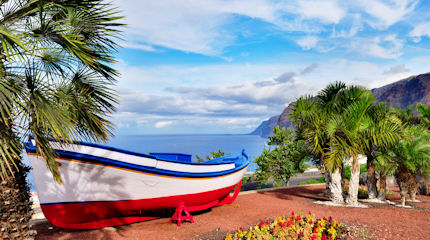
Tenerife is shaking off its image of old
Kevin Eaves / Thinkstock
Posh new resorts, a burgeoning restaurant scene and spiritual retreats are helping Tenerife recast itself as a destination for the discerning holidaymaker, while its sandy beaches, volcanic landscapes and warm weather sell themselves. Flight time from Britain? Four hours.
Red Sea retreat: Egypt
Hurghada’s golden beaches, scorching temperatures and world-class scuba diving are certainly no secret, but with the ongoing political unrest in Egypt there has probably never been a better time to visit the Red Sea resort where there are bargains aplenty and crowds are scarce.
Immerse yourself in the Red Sea at Hurghada
Igor Borisov / Thinkstock
Whether you want to scuba dive on coral reefs, trek through the desert or pander to pleasure in one of the five-star resorts, Hurghada has a gamut of options for the sun-seeking holidaymaker. And with direct flights from London to Hurghada, this Red Sea retreat is just five hours away.
The smiling coast: Gambia
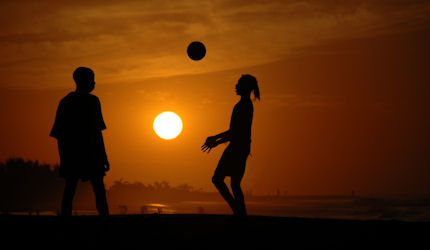
Soccer at sundown on a Gambian beach
Rafa Ocon / Thinkstock
Dubbed the “smiling coast of West Africa”, Gambia has long been Europe’s shortcut to the tropics. This former British colony might be the smallest nation in mainland Africa, but it punches well above its weight as a holiday destination… and it’s just five hours from London.
Most come to imbibe sunshine on sandy beaches, others to marvel at the world-renowned birdlife (Chris Packham is a regular). The more adventurous traveller can don hiking boots and trek through the jungle or cruise up the Gambia River in search of pygmy hippos and crocs.
Cape crusader: Cape Verde
Tourism is on the rise in Cape Verde, but you won’t be jostling for space on the beaches just yet. That will change, however, as holidaymakers arrive at this African archipelago in increasing numbers. Floating off the coast of Senegal, this former Portuguese colony boasts a surprising diversity of landscapes for such a small nation; sweeping sandy beaches, luscious mountain ranges and frozen lava fields are just part of the picture.
The golden beaches and limpid waters are the main draws, but the archipelago also offers excellent trekking, world-class windsurfing and a rich fusion of Portuguese and Cape Verdean culture – all within five hours of Britain.
Shortcut to summer - Cape Verde
 Cape Verde's beaches are just five hours from Britain
Nisangha / Thinkstock

Arabian allure: Oman
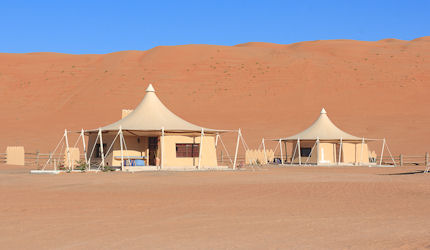
The jewel of Arabia, Oman is seven hours from London and this sunny sultanate is perfect for a midwinter getaway. With 1,700km (1,056 miles) of coastline, the country has no shortage of sandy beaches, which are glorious gateways to some of the best dive sites in the Middle East.
A Bedouin camp in the Omani desert
Charles Masters / Thinkstock
But sea, sun and sand are just part of the story; head inland and you can hike through verdant rainforests, camp with Bedouins and share epic vistas with mountain-dwelling shepherds. And spare a day forMuscat, the historic capital, where ancient palaces, grandiose mosques and bustling souks abound.

Beaches

A beach is a dynamic environment located where land, sea, and air meet. It may be defined as a zone of unconsolidated sediment (i.e., loose materials) deposited by water, wind, or glaciers along the coast, between the low tideline and the next important landward change intopography or composition. This change can be a natural feature such as dunes or a cliff, or a humanmade structure such as a seawall.
Although most beaches are composed of quartz sand, the fragments may be as large as boulders, or composed of some other material such as carbonate skeletal or shell fragments. Sources of beach material include sediment carried by rivers or eroded from cliffs or the seafloor, or biological material such as coral.

Parts of a Beach

A beach is comprised of two major parts: the foreshore and the backshore. The foreshore, also called the beach face, is the intertidal seaward portion. The backshore, or berm, is above the high tideline and is covered by water only during storms or unusually high spring tides. The foreshore's slope is steeper, whereas the backshore is nearly flat.

Zones.

There are several zones seaward of the foreshore. Farthest out is the breaker zone, where waves coming in from the ocean become steeper and higher and begin to break. Nearer to shore is the surf zone, where waves actually break, and longshore transport occurs.
The swash zone is considered part of the foreshore, and is the area exposed to wave uprush and backwash (the forward and backward movements of waves). Beach material is constantly moved in the swash zone, usually upward at an angle in the process called beachdrift . The surf zone and swash zone together make up the zone of littoral transport .

Beach Currents

The momentum of the waves, which break at an angle to the shoreline rather than running into it head-on, creates a flow parallel to the beach, known as the longshore or littoral current. This current picks up and carries sediment along with it, in the process called longshore transport or drift. The sediment is later deposited either on the beach, or as longshore bars of sediment just above the high tideline that are built up parallel to the coast and may eventually become barrier islands.
In contrast to longshore currents, rip currents or rip tides move sediment offshore. These currents form perpendicular to the shoreline when water brought to shore by breakers returns seaward via depressions in the seafloor or through breaks in offshore bars. Rip currents are narrow and localized and can move with speed and force. They are the source of undertow, about which swimmers are often warned.

Barrier Island Migration.

A barrier island is an enlarged longshore bar that may be up to 30 meters (98 feet) high and contain dunes and vegetation.* It is slightly offset seaward from the mainland, parallel to the shore due to its formation by longshore transport. The end of the island that faces into the longshore current is constantly being eroded. The sediment, though, is picked up by the current and deposited at the other end of the island. Thus, barrier islands migrate continually in the direction of longshore transport.

Storms and Beaches

Beaches can have different shapes according to the season. Waves tend to be long and low in the summer and wash sand onto the beach, increasing the size of the backshore. During the winter, waves become higher and more closely spaced. They possess greater energy that erodes the backshore and carries sand away temporarily. Winter storms magnify the effect, as do tropical storms and hurricanes in the summer.
The primary danger to a beach during a hurricane is the storm surge, which occurs when the low atmospheric pressure associated with a hurricane creates a "hill" of water in the ocean. The mounded water moves with the hurricane toward land. Upon approaching shallow water, the part of the mound over which wind is blowing produces a surge of elevated water pushed by the wind that inundates the beach.
The intense energy from a storm surge can badly erode a beach. Storm surges also can be very destructive to any structures in low-lying areas. Even worse are tidal floods, which are storm surges that form at high tide.
Another danger to beachesparticularly in the Pacific Oceanis the tsunami, a seismic sea wave created by an earthquake that occurs on the ocean floor. These rare occurrences are commonly but incorrectly referred to as "tidal waves." Ocean water is displaced during the violent movements of major earthquakes and may move at speeds of up to 800 kilometers per hour (nearly 500 miles per hour). As the wave approaches the shore, it slows to less than 60 kilometers per hour (about 37 miles per hour), but increases in height to more than 15 meters (49 feet), causing extreme beach destruction and occasionally causing human deaths.

Erosion-Control Structures

Barrier islands and all beaches are highly fluid and nonpermanent in terms of location. They move all the time. Shorelines are the most dynamic, most changeable real estate in the world. However, many humans choose to live close to or even on beaches. They build homes and businesses on unstable ground.
Migration and erosion of beaches is a natural, expected process that would not ordinarily cause any problems except for these human structures and human presence. Because people desire to continue living in this hazardous area, a variety of measures have been designed to prevent or minimize beach erosion in order to protect such property.
Longshore processes, rather than seasonal onshore and offshore sediment movement, are the primary problems associated with living and working on beaches. Therefore, humans often employ so-called "hard structures" intended to improve navigation and reduce longshore beach erosion.

Groins.

One type of structure for erosion control is the groin. Groins are walls placed perpendicular to the shoreline for the purpose of catching sediment to build up a beach. They often are constructed in groups, with the intention that each will trap some of the material being transported by the longshore current. However, while deposition may occur in the updriftdirection, even more erosion will occur in the downdrift direction.

Jetties.

Like groins, jetties are placed at a right angle (perpendicular) to shore, but at harbor or inlet mouths in pairs. Their purpose is to prevent the mouths from filling up with sediment or eroding away due to waves and currents. This helps to stabilize channels, but jetties block the longshore transport of sediment, causing updrift beaches to widen, and downdrift beaches to erode. Eventually deposition at jetties may fill the channel anyway, and dredging or scooping out the material is only a temporary solution.

Breakwaters.

Breakwaters are walls constructed at some distance from and parallel to the coastline in an effort to break waves and reduce the effects of their force on the beach. Because the waves are not reaching the shore, the longshore current is halted and material accumulates, widening the beach. Dredging is sometimes necessary when too much sediment piles up behind a breakwater at the mouth of a harbor, and as with groins and jetties, erosion often takes place downdrift of the structure.

Seawalls.

Seawalls are breakwaters constructed up against and parallel to the shore, again as a way to break the force of waves. While seawalls can protect the backshore, they, as well as breakwaters, are subject to failure due to scour, or undercutting by waves.

Drawbacks of Structures.

Although all hard structures have relatively modest maintenance costs under optimum conditions, they are complex and expensive to build, and they rarely function as intended. They interfere with the natural, active littoral transport system and more often than not cause unintended, undesirable erosion and deposition. Hard structures protect the property of only a few people at the expense of many, for such projects are normally funded at least partially with tax money. Costs and concerns must be factored in before building begins.

Nonstructural Alternatives

Aside from structures such as groins, jetties, and seawalls, alternate methods of dealing with erosion can be employed. In a method known as beach nourishment or replenishment, sediment is dredged from offshore or brought in from another location and placed on a beach reduced by erosion. The additional measures of burying dead trees within dunes or planting other vegetation to hold sand in place help in constructing a positive beach budget; that is, so more material is gained or held in place rather than eroded and carried away. This helps to provide protection against erosion and has the added benefit of creating a larger recreational beach.
13 Amazing Reasons Why Couples Who Travel Together Stay Together

Cute-Man-And-Woman-Sitting-On-A-Beach-With-Sea
According to a survey of 1,000 couples about understand how important traveling affected their relationship positively, almost two thirds (63%) of the respondents claimed that traveling has helped them stay together. The truth is not so far-fetched, when you travel together, there are sudden and exciting elements that fire your relationship.

1. A common goal and purpose

They share a common goal and purpose to see the world together. The anticipation and yearning of unraveling destinations, committing themselves to an endless adventure somehow bonds such couples and offers them a reason to always want to be together.

2. Understanding and adjusting to their limitations

Traveling is revealing, not only to the outer world but also to each other. They discover their strengths and weaknesses and find out how to complement each on these roles as they keep on uncovering paths and destinations.

3.They have better communication

According to a survey it was found out that couples who travel together agree better and have fewer disagreements than couples who don’t travel together. Traveling makes them more understanding and patient for each other.

4.They have a better sexual relationship

According to a survey, couples who travel together have a better sexual relationship than couples who don’t travel together. Traveling together cuts the work and stress into half, enough to spark romance and affection. According to the survey more than three quarters of those who traveled admitted that they have a good sex life.

5. Experiencing something new together

The indelible treasure engraved in your hearts and minds when experiencing something together can be everlasting. What is new sort of creates a memory that will be forever unique to their relationships.

6. It reveals who they are to each other

Since you are together most of the time, there is a little space for keeping ugly secrets. There are no facades and you have to appreciate your partner the way he or she is. Whether he snores, has his underarm hair un-shaved or has her legs un-shaved, traveling reveals a bunch of ugly truths. And with this there is little or nothing to hide.

7.Their sense of humor is built together

You can’t travel together without turning up some humor here and there. There are times when things just go horribly wrong and you have to laugh over it. It could be the horrible food you just bought on the street corner, having your hotel room mixed up or losing a map… something goes wrong and it is enough to have something to laugh at and sustain your happiness along the way.

8. They live the romance

It goes beyond what you watch on cinema screens or read in any book, as a traveling couple you live the romance out of spontaneity and a state of mind that you could be led anywhere and something could sparkle another moment of beauty. It is never about the money but the experience that traveling together could bring. This is why 86% of respondents in a survey of traveling couples said that their relationship still had romance alive in it, compared to 73% of respondents who never traveled together.

9. They live in the moment

While other couples who don’t travel together worry about the future, and build their relationship with doubts, couples who traveled together were not worried about what was going to happen next because they were consumed and captured by the intensity of the wonderful moments experienced with each other. Traveling together didn’t give them the opportunity to over-analyze their situation and be critical on several subjects but made them appreciate the present moment.

10. They have become best friends

Since they have only each other to turn to and fewer disruptions by external bodies or persons they were able to give themselves their all to become better friends. They would stick with each other through challenges and differences to provide each other with the companion they need.

11. They are educated together

Traveling offers an opportunity for learning. And how do you feel with people who you learn a subject with? The learning experience bonds them together and offers them the opportunity to revel in knowledge as they open their minds and hearts to the world before them.

12. They are more forgiving

Traveling together offers room for mistakes to be made and flaws to be revealed. However there are challenges all along the way and couples who travel together understand the need for forgiving each other quickly and moving on.

13. They experience freedom together

Couples who have traveled together in the past relish the freedom and independence traveling provides. With such understanding they can find comfort in respecting each other’s solitude, privacy and sense of presence. This provides another healthy angle to the progress of their relationship.
Traveling together excites and offers you amazing reasons to always be together.

Best beaches and small islands for travel in 2014

2014 is the International Year of Small Island Developing States: tiny, remote and environmentally vulnerable spots. Here are 10 that need you – and are glorious too!

Palau

Snorkelling in Jellyfish Lake, Palau. Image by Reinhard Dirscherl / Waterframe / Getty Images.
The Micronesian nation of Palau isn’t formed so much of islands as giant green mushrooms. Certainly that’s how its Rock Archipelago appears: a bloom of over 200 lush limestone islets undercut by azure seas and fringed by sugary sand. It’s ideal kayaking territory, though if you tire of paddling, you can always flop overboard to float above some of the world’s best subaqua action (according to famed diver Jacques Cousteau). For added weirdness, save your snorkel for Jellyfish Lake, where millions of gelatinous zooplankton – which have lost the ability to sting – perform a benignly beautiful underwater ballet.
Palau International Airport, on Babeldaob island, has flights from Taipei (4hr 55min), Guam (1hr 45min) and Manila (2hr 35min).

Tonga

Aerial view of an island in the Vava'u group in Tonga. Image by Peter Hendrie / Stone / Getty Images.
Tonga is not your common or garden paradise. Yes, its 170-odd isles are idyllically sprinkled across the bluest South Pacific; its flawless sands are tickled by palms and want-to-dive-into seas. But it’s also the region’s only remaining kingdom, where globalisation has yet to entirely erode its Polynesian traditions: locals still weave mats, wear tupenu skirts and gossip over intoxicating kava. Ha’apai is the place for empty beaches and super snorkelling; Niuas is even more perfect and remote. Vava’u is preferred by the South Pacific’s humpbacks – each year, these whales come here to breed, and travellers come to jump in with them.
Humpbacks migrate to Tonga from around early July to late October; strict guidelines apply to swimming and watching the whales.

São Tomé & Príncipe

Image by Maria Cartas. CC BY-SA 2.0.
Middle of the world but not middle of the road, the equator-hovering outcrops of São Tomé and Príncipe form Africa’s smallest, and perhaps least-known, state. Part of a chain of extinct volcanoes, they hide in the Gulf of Guinea, west of Gabon, which explains why so few tourists manage to find them. Those that do are richly rewarded, though: there are miles of sandy beaches trodden only by fishermen; a jungly interior with a 2024m peak to climb; turtles and humpbacks splashing in the waters; and hotels set in crumbly colonial plantation houses, which offer an atmospheric cool-breezed base.
The dry season is June to September, wet is from October to May; humpbacks visit the waters off São Tomé from July to October.

Trinidad & Tobago

'Maracas, Trinidad' by neiljs. CC BY 2.0.
Bountiful birds, steel-pan bands, street food, rainforest, multiculture and a raucous Carnival – that’s what Trinidad’s made of. This is the Caribbean at its most exhilarating, least contrived and, strangely, most beach-free. There are nice strands, but Trinidad isn’t about lolling in paradise: it’s about living it. Besides, sister-isle Tobago fills all the basic sand-nirvana needs. Its west is edged with unspoiled palmy shores, where tourism remains low-key. Its east, however, is that bit wilder: South American–style flora blooms in abundance; caiman and other critters lurk in the forest; and the coast is notched with secret coves, perfect for that castaway feel.
Dry season is December to May, wet is June to November. The islands sit just outside the hurricane belt (hurricanes do occur at times).

Cook Islands

Image by Benedict Adam. CC BY 2.0.
Captain Cook would be proud. The 15-island archipelago that bears the explorer’s name is a beaut, incorporating some of the South Pacific’s best sand-palm-sea paradises (it’s impossible not to drool into Aitutaki’s cerulean lagoon). Better still, it’s accessible. Of course, when you’re talking specks in an 165-million-sq-km ocean, accessibility is relative. But with many an Oz-to-USA flight touching down on the main island, Rarotonga, visiting the Cooks isn’t just a pipe dream. Be warned, though: those that do stop-off – to hike through jungle, kayak to a private atoll or do nothing much at all – find it hard to leave.
Seasonal weather variations are slight: temperatures are from 18°C to 28°C May to October or 21°C to 29°C November to April.

Papua New Guinea

Tribesmen apply traditional paint to celebrate Sing Sing in Papua New Guinea. Image by Michael Runkel / Robert Harding World Imagery / Getty Images.
PNG is about the size of California. But within its broiling, savage and spectacular confines you’ll find, for example, more than 190 species of mammals, 650 species of (often bonkers) birds, 160 types of frogs and 820 different languages. Simply, it’s one of the wildest, most mega-diverse and most singular places on the planet. For tribal encounters, head to the Highlands (to Tari to meet the Wigmen, to Mt Hagen for its festival). But don’t ignore the coast, where reef walls drop to inky depths just metres from magnificent beaches to provide some of the best diving and snorkelling in the world.
Transport in PNG is challenging; its few roads are in poor condition. Internal flights and tours are the easiest ways to travel.

Cape Verde

Black volcanic sand beach at Sao Filipe, Cape Verde. Image by R H Productions / Robert Harding World Imagery / Getty Images.
First colonised by the Portuguese, geographically closest to West Africa and with a Latin vibe that feels a bit like Brazil, the Cape Verde archipelago is hard to pigeonhole. It’s pretty hard to place on a map, too, lurking some 500km off the coast of Senegal amid a whole lot of Atlantic Ocean. There are 10 islands, from lava-streaked Fogo to the luxuriant valleys of Santo Antão. But the best beaches belong to Boa Vista, an island virtually subsumed by sand: Sahara-style dunes ripple the interior, while miles of gorgeous graininess edge the breezy shores, perfect for windsurfing off into the blue beyond.
Boa Vista is an important nesting site for loggerhead turtles; the best time to see them is June to September.

Grenada

Sunrise at Tyrell Bay, Carriacou by Jason Pratt. CC BY 2.0.
You could come to the Caribbean’s lush-n-lovely Spice Island, plonk down on Grand Anse (its 3km-long beach) and be more than satisfied: the sand’s fine, the beach bars lively, the restaurants well stocked with seafood and nutmeg ice cream. But that would be a waste, for the mountainous innards of this Windward Isle have created coves and inlets ideal for secluded swims and snorkels. Even more intimate and a ferry-hop west is Carriacou, with wild sands only reached by hiking or sailing, and a thriving African culture that ensures a soundtrack of big drums and captivating calypso.
Up to three flights a day link Grenada and Carriacou; a crossing by ferry takes from 90 minutes.

Seychelles

Anse Lazio beach in the Seychelles. Image by Jean-Pierre Lescourret / Lonely Planet Images / Getty Images.
Nary a ‘world’s best beach’ list is compiled without the Seychelles getting a mention. This clutch of 115 islands sprinkled in the Indian Ocean got all the good genes: its waters are clear and teeming with life; its sands are sensuously soft; its interiors are wild and luscious; even its coconuts – the buttocky coco-de-mer – are sort of sexy. The three main islands (Praslin, Mahé and La Digue) are perfectly pretty. Even better are Curieuse, where giant tortoises lumber, and the coral atoll of Aldabra, uninhabited but for more tortoises (the world’s largest population), plus turtles, sharks, coconut crabs and a wealth of species besides.
Seychelles International Airport is 8km south of Victoria, on Mahé. Regular ferry services run between Praslin, Mahé and La Digue.

St Vincent & the Grenadines

  Pink clouds in Charlestown Bay, Canouan. Image by Jason Pratt. CC BY 2.0.
Know your budget, choose your boat – that’s the key to unlocking this lovely island chain in the southeast Caribbean. If your wallet’s well-endowed, travel by private yacht, from large, green and gorgeous St Vincent down the tail of the unblemished Grenadines – small specks, big on charm. Those without an oligarch’s income should hop by fun ferries. Join the locals (and their luggage/mail/chickens) making their way from St Vincent to Bequia’s lively waterfront, the fine sands of Canouan, rugged Union and languid Mayreau; from here, the deserted Tobago Cays (where one Jack Sparrow was once cast away) beckon beautifully just to the east.
The MV Barracuda and MV Gem Star ferries operate regular services between Kingstown (St Vincent) and the southern Grenadines.