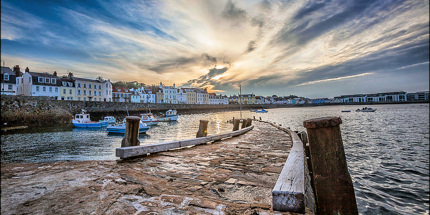
ust a short hop, skip and a jump away from the UK, Jane Duru discovers that beneath Guernsey's picturesque surface lies a quirky gem full of historical sights and excellent beaches.
On first impressions, this could almost be any charming countryside village in the UK. Our morning’s bus tour of Guernsey has taken us down sleepy country lanes lit in glorious sunshine and surrounded by lush green hedgerows dotted with bright yellow gorse bushes. Pastoral scenes of cows grazing peacefully in the meadows roll by, and the signs of rustic idyll are complete with every ivy-clad chocolate box cottage that comes into view.
"Look out for hedge veg," says Gill, our guide, referring to the local practice of buying vegetables by taking home-grown produce from roadside stands and leaving payment in lieu; honesty, it seems, is not an endangered commodity here. Nor is candor, as halfway through our tour, Gill pronounces: "We’re Guernsey donkeys." I shoot her a quizzical look – donkeys? But she insists that the term isn’t derogatory; locals here are proud to be as stubborn and hard-working as their animal counterparts. The term for Jersey-ites, crapaud, meaning toad, seems somewhat less redeeming.
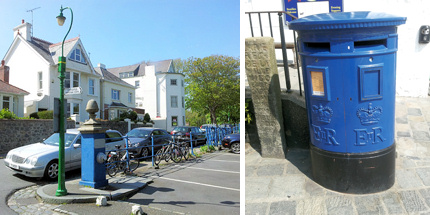
Guernsey's street furniture adds continental flavour
WTG / Jane Duru
So far, so Cotswolds-charming. Still, the giveaways are there. Only
an hour's plane ride away from London, here the street names are in
French as well as English, and the cutesy houses are called things like
‘La Meriais’, ‘Glenwood’ and ‘Fief Le Roi’. Blue postboxes and art
nouveau-esque street lamps help impart that continental flavour, whilst
with a little gentle eavesdropping on local conversations it’s possible
to catch some Dgèrnésiais (the French Norman patois unique to Guernsey)
still being spoken – despite being part of the UK, Guernsey is only 45km
(27 miles) off the Normandy coast. At one point, I make the mistake of
referring to ‘the mainland’. Gill doesn’t correct me but speaks of
England or the UK instead; the Channel Islands' self-governing status is
an obvious source of fierce pride.WTG / Jane Duru
The bus makes a turning off the road, parks up in a small car park and we’re taken up a small path through grassy terrain. As we round a corner, Gill stops and motions to duck through a hole in the bushes to our right. One by one we pass through, and emerge through into a small clearing: in front of us is a grass-covered mound with a small entrance hole. This is Le Creux ès Faïs: translation – The Fairy Grotto. On the west side of the island in L’Eree Bay, one of several pre-Christian dolmens dotted around the island. The 5,000-year-old chamber is said to be the entrance to the Guernsey fairy kingdom, with the east-facing entrance to catch dawn’s first light.
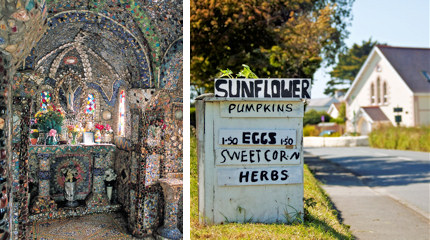
Left, the Little Chapel; right, hedge veg
Visit Guernsey / Chris George
It’s neither our first nor last encounter with Guernsey’s eccentric
history; this tiny island, at only 11km (7 miles) long and 5km (3 miles)
wide, is densely packed with evidence of its eclectic past. A previous
stop had taken us to the 100-year-old Little Chapel in St Andrew’s
parish, a tiny chapel with its surfaces gilded in thousands of broken
seashells and crockery. Further southwest, in the parish of Torteval,
visitors to the cliffs can see the imposing remnants of two concrete
military bunkers that the Germans built when they occupied the island
between 1940 and 1945. Having been blocked up after the war – an attempt
at easing painful memories – the bunkers are now in the process of
being cleared out, the eventual aim being to open them up to the publicVisit Guernsey / Chris George
The island’s wartime ordeals are further on display the next day, when we head to the German Occupation Museum in St Andrew. The work of a private collector, it gives an excellent insight into occupied Guernsey with exhibits detailing everything from uniforms and surgical instruments, to machine guns and unexploded bombs; there’s even a reconstruction of an occupied street.
Back in Torteval, the brutalist feel of the bunkers only serves to highlight the loveliness of Guernsey. Swallows swoop above the verdant cliffs, which are carpeted in a blanket of colourful flowers. In fact, throughout the island, the natural hues just seem to ‘pop’. There's no time to attempt the 45km (28 miles) of clifftop walks but the evidence of Guernsey's natural beauty is confirmed with a later visit to the capital, St Peter’s Port. Here, a gentle amble around the restored Victorian Candie Gardens takes me through flower beds woven with blooming clematis, azaleas, rhododendron bushes and magnolia trees, whilst a large statue of Victor Hugo (who, along with Jenson Button, was one of the island’s more famous residents) dominates the park area.
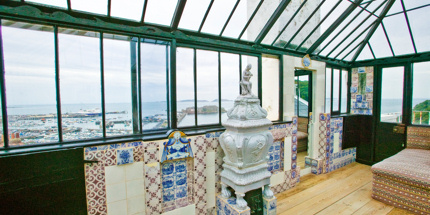
Victor Hugo worked in his lookout room, with views across the harbour
Visit Guernsey / Chris George
Hugo came to Guernsey in 1855 after being exiled from France, and
kicked off Jersey, his first choice. His well-preserved home Hauteville
House, where he lived for 15 years and completed Les Misérables,
is another episode of Guernsey’s history worthy of further
investigation. I spend a morning touring the house, gaping in awe at
the ingenuity and egotism on display in his jewel box of a house. Each
room seems chock-full of symbolism (every room incorporates the initials
VH within it) and interior decorating touches that would make Laurence
Llewelyn-Bowen blush at the excess of it all – it’s eccentric in the
extreme, but I really enjoy it nonetheless. One room is entirely covered
in tapestries apart from one wall, where a ceiling height wooden
mantelpiece made out of 75 chests of drawers takes centre stage. The
pièce de résistance must be the lookout, a top-floor study where Hugo
would work in the mornings, after having gone for a 6am swim and
swallowed two raw eggs for breakfast. Up here, the views stretch out
over the harbour, and even to France on a clear day.Visit Guernsey / Chris George
Of course, one of Guernsey’s major attractions is its beaches – with 27 of them, the island makes a great holiday spot, not just for sunbathing and beach walks, but for activities too. The western beaches of Vazon Bay are popular with kitesurfers, whilst L’Ancresse Bay in the north is said to be the most beautiful.
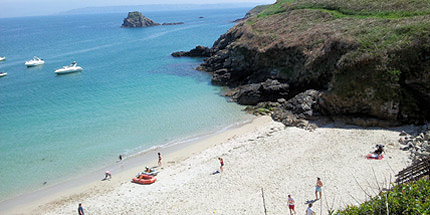
Spend a day on Herm's beautiful Belvoir Bay
WTG / Jane Duru
An afternoon spent sea kayaking and coasteering on the southern coast with Outdoor Guernsey
reveals a blue sea that’s almost Mediterranean in its intensity and
clarity. We’re down at Petit Bot Bay, where a small café looks out onto
the beach, surrounded by rugged green cliffs and small rocky outcrops.
Ant, the group leader, is showing us how to grip the paddle correctly
before we head out for a gentle kayak. From the water, the bay looks
magnificent, with birds freewheeling above us, but it’s the coasteering
that has me sweating with excitement. Or is it nerves? I scramble up the
cliff rocks before taking an adrenaline-inducing jump off one, into the
deceptively cold sea.WTG / Jane Duru
If your idea of beachside exertions is a stretch for the suntan lotion, then a day trip to the neighbouring island of Herm is a must. At only 2 sq km (0.8 sq miles) wide, and with cars and bikes banned, it’s a recipe for the nostalgic days of older, more innocent times, like something out of Swallows and Amazons. As the 20-minute ferry from St Peter Port pulls into shore, we watch a wedding being conducted on the beach, and later wave to the happy couple as they pass by on the back of a tractor to do a celebratory lap of the island. The coastal walk takes us through shady paths lined with bluebells, up to the highest viewpoint on the island, and past Belvoir Bay and Shell Beach where the white sandy beaches appear to have been plucked straight out of the Caribbean.
The calm, castaway feel of Herm is an unexpected pleasure, and as I wander through the long grass to catch the ferry, I begin to understand how these islands manage to weave their magic over visitors, with a captivating charm that’s neither French nor British, but all their own.

No comments:
Post a Comment